Sunday, February 27, 2011

Pepperland - then and now

The music hall called Pepperland is somewhat of a legend in Marin County lore. Although it was open, on and off, for less than three years, and fully operational for less than a year, it played host to a pretty amazing and diverse roster of international talent, including Pink Floyd, Captain Beefheart, Chuck Berry, and many others.  I got up to Pepperland two times, once to see what was billed as the Acoustic Grateful Dead and another time to see a dynamite quadruple bill of Grootna, Lamb,  Boz Scaggs, and Taj Mahal’s tuba band.  Pepperland has been discussed recently on a couple of the Bay Area related music blogs, so I thought I would deviate again from a chronological diary of shows to talk about this funky little venue.

Bermuda Palms 1950s? Image courtesy of Rebecca David.
(Check out her great book, Mid-Century By the Bay
calmodbooks.com)
The Aliens performing at Bermuda Palms, early 1960s. This is clearly the same stage setup used when the hall became Pepperland. 
Pepperland had its origins as part of a motel/restaurant complex called the Bermuda Palms which was built in the 1930s by a San Rafael builder/entrepreneur named Whitey Litchfield.  Located in downtown  San Rafael at 737 E. Francisco Blvd., just off of Highway 101, the club was readily accessible from Sonoma, San Francisco, and the East Bay, yet it was far enough away from those centers to have a distinctly laid-back Marin County vibe.

Poster from the Janis/Big Brother/Gold Hell's Angel's
Party 5/21/70
The layout of the Palms is shown nicely in the 1967 postcard shown above (the cars in the parking lot suggest that the picture was taken much earlier). The ballroom, adorned with the large Litchfield's sign, was located on the front of the property and the W-shaped motel was behind the hall and between Francisco Blvd. and Front Street. A photo taken at an Aliens gig in shows what the hall looked like in the mid-1960s (read more about the Aliens here). A Bermuda Palms poster shows a bill featuring the Sons of Champlin, as does the poster for the infamous Hell’s Angel’s party in the club on May 22, 1970 featuring Janis Joplin and Full Tilt Boogie, Big Brother, and Gold (admission $1!) still had the site identified as the Palms.

By late June of 1970,  the dance hall at Litchfield’s was renamed  Euphoria, and had a brief, but storied,  stint that included gigs by Big Brother as well as two nights featuring the Grateful Dead, the New Riders, and Rubber Duck. David Crosby participated in the Dead’s acoustic set the first night and, at the second,  Janjs Joplin appeared again to trade boozy sexual innuendos with Pigpen on “Lovelight.”

The Glyph sound system at Pepperland circa 1970-71


At the end of July, the club closed its doors while it underwent an extensive facelift, emerging in mid September as Pepperland, a Beatles-themed hall that featured a quadraphonic sound system that was one of the earliest projects for sound engineer John Meyer, who  later founded Meyer Sound, the East Bay company that started out building custom PA systems for the Dead and others, and has developed into one of the world’s premier sound reinforcement developers and manufacturers.

To complement the psychedelic décor, the support girders for the hall’s roof were adorned with painted portholes that mimicked the designs present in the fanciful craft piloted by the Beatles in their 1968 cartoon movie Yellow Submarine.  Even the sound system blended into the décor, with the speakers molded into huge conical fiberglass structures as shown above.What appears to have been Pepperland’s grand opening featured an eclectic triple bill of Hot Tuna, Captain Beefheart’s Magic Band, and jazz flute maestro Charles Lloyd. From then well into 1971, the club offered really interesting triple bills of acts that would normally be Bill Graham’s stock in trade in the city. Notable among these was a legendary Pink Floyd gig in which the band needed to use the ballroom floor to accommodate  all of their gear, and one of the shows was plagued by power failures as Floyd’s massive sound system taxed the club’s electrical capacity.  The relatively Pepperland portion of the gig list below was culled largely from the web site of Universalightforms, a site run by Bob Pulum, founder of legendary light show crew the Brotherhood of Light, who became the house visual artists at the club beginning with the club’s second gig with Frank Zappa and the Mothers.  According to Pulum’s site,  Pepperland’s first incarnation lasted from that initial show until an April 11, 1971 bill with Quicksilver,  Hot Tuna, and Lizard, after which the promoters allegedly split with the proceeds of that show.  Pepperland reopened in September with some of the original employees, including the BOL, in place, but the new venue seems to have only stayed open a few months, closing for good in January, 1972.  A nice selection of poster images from Pepperland and Euphoria can be found in this page at the great Chicken on a Unicycle web site.

The Litchfield’s motel appears to have been open during this entire time and developed somewhat of a shady reputation in the 1970s. This reputation is supported indirectly by the Grateful Dead tune "Shakedown Street," which was written  in 1978 about the neighborhood surrounding the band’s Front Street studios, which were directly across the street from the rear of the Litchfield’s complex.

Today the site houses a somewhat gentrified Motel 6. In front of the motel is a large building that recently housed the Zebra sofa store, and which was clearly the original Euphoria/Pepperland building. In 2008, the historic Litchfield’s sign was restored on the building through the efforts of Perry Litchfield, Marin County lawyer and Whitey’s son.

Jerry Garcia and David Crosby
Pepperland 12/21/70 Photo: M. Parrish
When I visited Pepperland in 1970 and 1971, it seemed like quite a trek up to the wilds of Marin from Palo Alto, but at least the hall was easy to find once in San Rafael,  located as it was on a frontage road right off of 101. What was immediately impressive about the hall was its modest size. Although it competed directly with the Fillmore West for headliners, Pepperland seemed to have been, by the most generous estimate, no more than half the size of the F. West/Carousel, which was already relatively tiny by today’s concert hall standards. As you can see from the photos, it had less-than-optimum dimensions for a music hall, a long, low building with exposed horizontal girders supporting the wide A-framed roof.  In its Pepperland makeover, these became girders of the enormous submarine one was supposedly inside within the hall. An interesting concept, but not an entirely convincing fantasy.  However,  combined with the exotic Meyer sound sculptures and the light show (it appears that none was operational at the 1970 gig, but Brotherhood of Light was very evident at the Mahal show) made for a fairly exotic interior setting, particularly when contrasted with the utilitarian trappings that surrounded the building.

George Marsh and Jerry Hahn Pepperland 12/21/70
Photo : M. Parrish
The 12/21/70 concert has been written about at length elsewhere, most recently in a lengthy blog post by Jerry Garcia’s Middle Finger. The photos I took at this gig are truly terrible as I was unable to adjust for the very low light conditions, but I was able to adjust the images using photoshop, and share a few of them here to give a bit of visual record from the event. These first two images just came to light a few weeks ago when I found a fragment of negatives from the first part of this show. What proved to be a marathon evening of music got underway with a spectacular set by the Jerry Hahn Brotherhood, one of the Bay Area’s most amazing, but generally unheralded, musical aggregations of the era. The group, comprising jazz guitarist Hahn, blues-rock keyboardist and vocalist Michael Finnegan, and the superb rhythm section of drummer George Marsh and bassist Mel Graves, had a relatively short lifespan, disbanding soon after the show I attended. Rocking hard, armed with a splendid set of songs mostly penned by non-member Lane Tietgen, this short lived quartet was very much akin to a Bay Area version of The Band.  They did release one fabulous, eponymous album on Columbia, but never achieved the popularity they richly deserved. This was the only time I got to see them, and I believe the group broke up shortly thereafter. I will write much more about this great group at a later date.

Mystery Musicians Pepperland 12/21/70
Photo: M. Parrish
What happened next is not entirely clear. I know that John Kahn played an unbilled set as (I believe) just a duo with a blues guitarist whose name I do not remember (none of the usual suspects like Bloomfield. Gravenites, Bishop, or the like) but I seem to have no photo record of this set. On the other hand, I do have this enigmatic photo of a jazz guitarist and drummer that was positioned chronologically on the film between shots of Hahn and the New Riders. As noted in the jgmf post and the attached poster, Howard Wales was billed in the advance posters. In a response to jgmf, I indicated that Wales had not played, but it is conceivable that he did play and I did not remember it. It was a very long evening of music, and an additional set by Wales and company would perhaps get the headliners coming on as late as they in fact did appear. What I believe I expected was for Garcia to play with Wales, which did not happen. At the time, seeing Wales himself would have been no big deal, as I had seen him a number of times with A.B. Skhy. So either this photo is of the guys who played with Kahn or perhaps part of Wales' band. Neither of the more familiar musicians are visible, so this is likely to remain a mystery unless more information is forthcoming. The guitarist looks somewhat like Terry Haggerty, but I am pretty confident that it is someone else.

Spencer Dryden and David Nelson of NRPS
Pepperland 12/21/70 Photo: M. Parrish
After Kahn and friend(s) came the New Riders of the Purple Sage. I'd seen them many times in 1970, but this was the first time I had seen them with Spencer Dryden on the drum kit instead of Mickey Hart. They played a nice long set, with no real surprises except for the switch in drummers, and finished up well after 1 AM.

Jerry Garcia's nose and David Crosby
Note: Garcia playing an SG and Crosby a Gretsch 6 String
Pepperland 12/21/70 Photo: M. Parrish
The headliners were billed as the "Acoustic Dead" but the group that took the stage was an impromptu quartet comprising Garcia, Lesh, Kreutzmann, and David Crosby. Two tapes of this ensemble (it remains an open question whether Mickey Hart substituted for Kreutzmann in the earlier gigs) from the Matrix a few days earlier (the exact date(s) of those tapes are debated) circulate widely, but their tenure was short lived, and this may have been the last time the quartet performed. I was only able to hear part of their set, which opened with "Alabama Bound" and also included "Deep Elum Blues," "Motherless Children" and "Triad." Clearly they played a lot more (which, based on the tapes from the Matrix show, would have included primal versions of "Bertha" and "Bird Song"), but at that point I was dragged out by my father, who had to go to work the next morning. As noted elsewhere, at least Weir and Pigpen could be seen wandering around backstage, so it is likely that the Dead did indeed play later.


There seemed to be nothing like a curfew at Pepperland, and the musicians were clearly in no hurry to get anywhere.
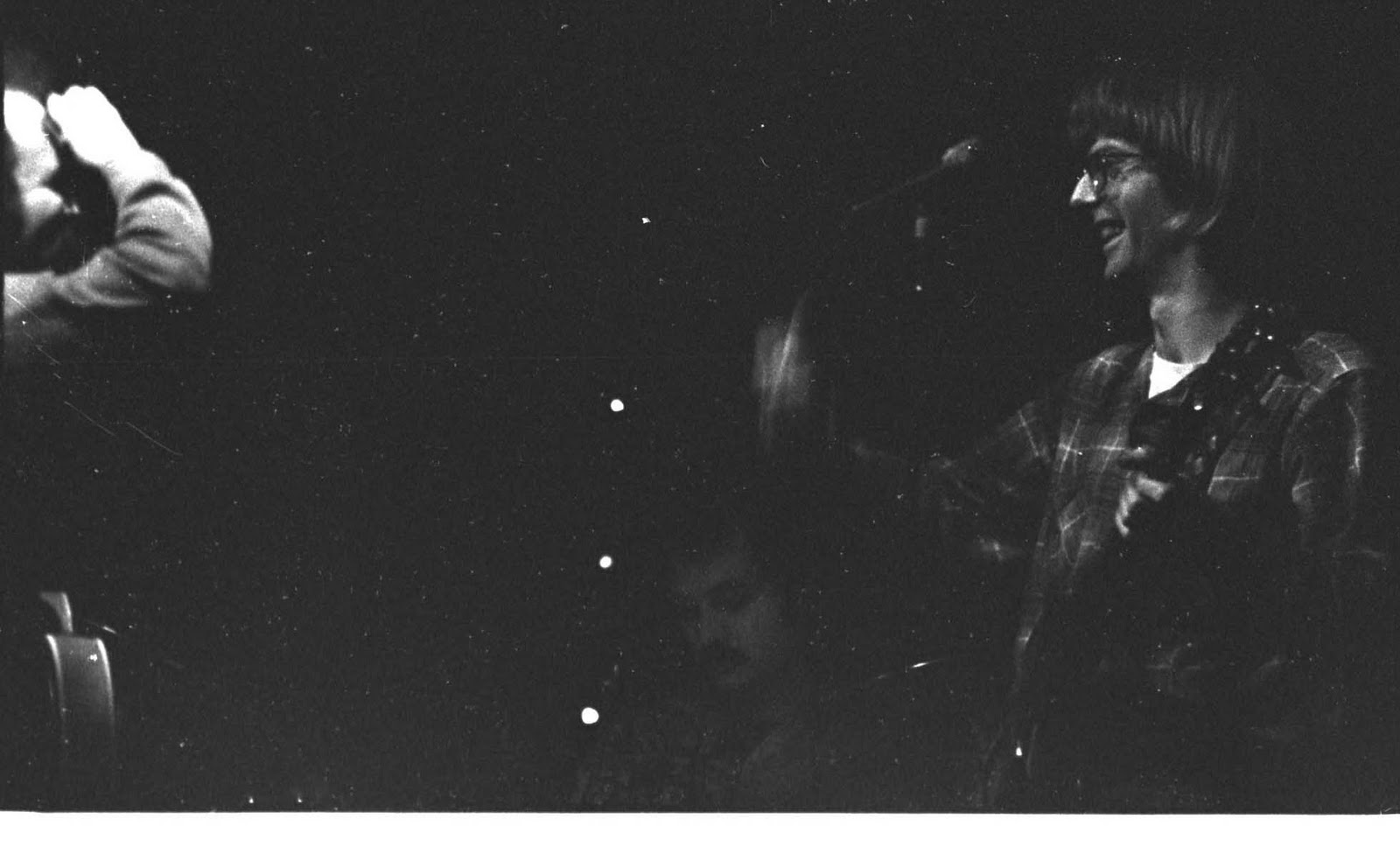
Crosby, Kreutzmann, Lesh Pepperland 12/21/70
Photo M. Parrish
An interesting question begged by this show's billing, as well as that for the 12/31/70 New Year's show, was the specific timing of the demise of the Dead's 1969-70 acoustic sets. Both of these shows advertised the Dead playing acoustically, but it appears that this did not come to pass at either gig. The last shows at which acoustic sets are verified are the 11/5-8/70 Capitol Theatre shows, and a plethora of subsequent November (11/16, 11/20, 11/29) and December (12/12, 12/26-28, 31) shows are known that do not include acoustic sets. The reasoning for the abandonment of these sets is unclear. The amplification of the acoustic sets was always problematic, and Mickey Hart's imminent departure may have also figured into the issue. Whatever the reason, there is no documented record of the band stepping onstage with acoustic guitars until the 11/17/78 Hunger Week benefit in Chicago (which I got to attend, and will write about another day).

The issue of the drummer for this ensemble has been a source of some confusion. When the tapes of the Matrix show first circulated in the mid-1970s, the tape notations listed Mickey Hart as the drummer. During the Dead's acoustic sets in 1970, who provided percussion seemed to be almost random. Either Kreutzmann or Hart would generally be the principal drummer (except on the many occasions when only Garcia, Weir, and Lesh performed without percussion), so seeing a sole drummer onstage was no big deal. When I was recently able to scan the negatives from this show, it became clear that the drummer this evening was Kreutzmann, not Hart, so it seems equally likely that this was the case at the Matrix show/rehearsal earlier in the week. As discussed over at JGMF, I do not recall seeing Hart in the hall (and only one drum kit was onstage), so he most likely did not perform that evening at all.

Taj Mahal Tuba Band at Pepperland 4/2-4/71
Photo: Dr. Che
The only other time I made it to Pepperland was the next March, for a great bill of three hometown acts and headliner Taj Mahal with his unique four tuba band. As noted earlier, the Brotherhood of Light did provide visuals for that show, which was one of the last under the sponsorship of the original Pepperland booking agents. This show opened with an unbilled set by Grootna. Although this group did perform during the closing week of the Fillmore West, and recorded a single, eponymous album for Columbia produced by the Airplane's Marty Balin, they never really broke nationally, or even achieved headline status in the Bay Area. Grootna consisted of vocalist Anna Rizzo, guitarists Slim Chance and Vic Smith, bassist Kelly Bryan, and drummer Greg Dewey,  who had played at Woodstock in the final incarnation of Country Joe and the Fish and went by the nom de plume of Dewey DaGreeze in Grootna. The group's tight blues-rock set probably consisted principally of material from their single album.

Next up was Lamb, which had originated as an acoustic duo consisting of guitarist-vocalist Barbara Mauritz and guitarist-keyboard player Bob Swanson. By the time of this show, they had expanded to an electric quartet, which included bassist David Hayes and a percussionist. The group's eclectic material was jazz influenced, and driven by Mauritz' powerful, hypnotic vocals. Their second album, Cross Between, featured Jerry Garcia on three cuts.

During 1970 and 1971, one of the Bay Area's best bands was the octet led by by Boz Scaggs. After departing the Steve Miller Band at the end of 1968, Scaggs took a year or so off from performing, but cut a legendary, eponymous album in Muscle Shoals with a lot of help from Duane Allman. When that album garnered a lot of airplay. Scaggs went ahead and assembled a band to, as much as possible, capture the tight big band sound he had captured on the album. The new group featured drummer George Rains (late of Mother Earth and the Sir Douglas Quintet), bassist David Brown, jazz keyboard player Jymm Joachim Young, guitarist Doug Simril, and a horn section comprising sax player Mel Martin, trombonist Patrick O'Hara, and trumpeter Bill Atwood (replaced at some point by Tom Poole). The group's diverse sets were drawn mostly from the Atlantic Scaggs album and the band's first Columbia album, Moments, both of which featured a blend of rockers and soulful ballads that were very different than the disco material that brought Scaggs his greatest commercial success in the late 1970s and 1980s. A high point of their sets as the time was a long, spacy version of "Baby's Calling Me Home" which Scaggs had contributed to the first Steve Miller Band album, Children of the Future.

Taj Mahal was ubiquitous in the Bay Area during the era, but this was the first time, to my knowledge, that he performed locally with the remarkable band he assembled for a couple of tours that was documented in The Real Thing. Taj was always staking out new musical territory, but the so called "Tuba band" was perhaps his most audacious (and probably expensive) experiment. Comprising first call musicians like guitarist John Hall (later leader of Orleans), one-time Hendrix bassist Billy Rich, pianist John Simon, drummer Greg Thomas, and conga player Kwasi "Rocky" DziDzournou, the group's most startiing element was the quartet of tuba players led by Howard Johnson and also featuring Bob Stewart, Joseph Daley, and Earl McIntyre.

Few vocalist-guitarists have enough presence not to be upstaged by a quartet of tubas, but the combination worked remarkably well. Taj used the tubas mostly to provide a tremendous bottom to tunes like "Sweet Mama Janisse" and the extended "You Ain't No Street Walker Mama, But Honey I Love the Way You Strut Your Stuff." After doing a couple of songs solo, Taj brought the rest of the musicians out for a slow, breezy version of "Ain't Gwine To Whistle Dixie (Anymo') highlighted by both exclamations from the tuba section and Hall's jazzy guitar. It was a great set and, given that it was a Saturday night, we stayed until the end. 

The Interior of the Pepperland Building Circa 2/2011
The stage was located back by the flat Screen TV and
the exercise balls. Photo: M. Parrish
The Bermuda Palms/Euphoria/Pepperland Building
Circa 2/2011 Photo M. Parrish
Curiosity about the current state of the building and the Litchfield’s site led to a Cryptical Road Trip to sunny San Rafael, Taking the exit off of 101 that leads to the Richmond San Rafael Bridge onramp, a sudden sharp left turn leads to Francisco Blvd., a high volume frontage road that parallels 101 on its eastern side. A few blocks northward,  the Litchfield’s property loomed, replete with the large, restored sign. Emerging from my car I discovered that the building has been carved up into a few retail areas,  one of which is currently occupied by a Fitness Warehouse. Comparing the interior photo to the best shot I could find of Pepperland in its prime (a great shot by Dr. Ché from the interior of Taj Mahal’s Real Thing album, which  was not recorded at Pepperland, but at the Fillmore East), it appears that the stage area was located just about where the exercise balls now reside. Needless to say, the submarine trappings are long gone, as is the Meyer-built Glyph sound system. The proprietors of the store had no idea of the building’s illustrious past, but also didn’t seem all that interested.

The former site of Le Club Front as of 2/2011
Photo: M. Parrish
Being in the neighborhood, I popped around the corner to pay my respects to the former site of Le Club Front. The warehouse, which most recently housed a plumbing supply store, is currently unoccupied. I got out to take some photos, but beat a hasty retreat when a truck pulled up to the curb and what looked like some clandestine transaction got underway.  It was clearly time to bid adieu to shakedown street,  and a memorable bit of Marin County rock history.


Gig Lists

Bermuda Palms

7/28/67             Sons of Champlin, Baltimore Steam Packet,  Thursday’s Island, Mieville Square,  The IV Kings.

5/21/70            Hell’s Angels Party with Janis Joplin and Full Tilt Boogie (billed as Main Squeeze, but they had broken up by then), Big Brother and the Holding Company, and Gold.


Euphoria

7/3,4,5/70  Big Brother and the Holding Company, A.B. Skhy, Joy of Cooking

7/14, 16/70 Grateful Dead, NRPS, Rubber Duck

7/20/70  Country Joe and the Fish, Southern Comfort

7/24,25,26  Chambers Brothers, Boz Scaggs, Southern Comfort


Pepperland 

9/18,19/70 - Pepperland Ballroom Hot Tuna, Capt. Beefheart, Charles Lloyd

9/25,26/70 - Pepperland NBL Productions - Frank Zappa & Mothers, Tim Buckley, Kindred

10/16,17/70 - Pink Floyd, Kimberly, Osceola

10/24,25/70 - Steve Miller, Jerry Hahn, Dan Hicks & Hot Licks

11/13,14/70 - Incredible String Band, Doug Kershaw, Joy Of Cooking

11/28/70 - Leon Russell, Capt. Beefheart, Clover, Truk

12/18,19/70 - Chuck Berry, Sir Douglas (or Edward’s Hand?) , Boz Scaggs

12/20/70 - Joan Baez

12/21/70 – Grateful Dead?, Crosby/Garcia/Lesh/Kreutzmann, John Kahn and Terry Haggerty, NRPS, Jerry Hahn Brotherhood

1/22,23/71 - Youngbloods, Sea Train, John Fahey

1/29,30/71 - Cold Blood, Boz Scaggs, Stoneground

2/5,6/71 - Elvin Bishop, PG&E, Tower Of Power

2/20,21/71- Big Brother, The Sons, Clover

2/26,27/71- Spencer Davis, Dan Hicks&Hot Licks, Country Weather

3/5,6/71- Steve Miller, John Lee Hooker, Bronze Hog

3/12,13/71- Lee Michaels, Joy Of Cooking, Fourth Way

3/11/71 - Linda Ronstadt, Clover, Little John, Chris Darrow

3/19,20/71 – It’s A Beautiful Day, Odetta, Victoria

4/2-4/71 - Taj Mahal, Boz Scaggs, Lamb, Grootna

4/11/71 - Quicksilver, Hot Tuna, Lizard
Last NBL show

9/9-11/71 - Steve Miller, Yogi Phlegm, Nazgul, Clover

9/24,25/71 - Mike Bloomfield, Stoneground, Clover

11/13/71- Tower Of Power, Cold Blood, Norman Greenbaum

12/4/71 - Boz Scaggs, Earthquake, Staton Bros.

12/11/71- Joy Of Cooking, Commander Cody, Crossfire

1/22/72-  Tower Of Power, Redwing, Roger Collins

Friday, January 28, 2011

IABD at Frost, The Dead at Winterland, and CSNY at UCSB


Old Davis, Stanford 10/5/69 Photo: M. Parrish

Looking back on 1969, I actually was able to see quite a bit of music for a kid without a driver’s license.  The fall brought several more memorable concerts, including another memorable multi-act bill at the Frost Amphitheatre, my first of many visits to the late, lamented Winterland, and a chance to see Crosby, Stills, Nash, and Young in their formative period.

As mentioned in an earlier post and in several places on the MFU site, the Midpeninsula Free University had to abandon their El Camino Park Be-Ins in 1968. However, they continued to sponsor music events, and the October 5 SCORE (Stanford Committee on Radical Education) concert held at Frost Amphitheatre was sponsored by the MFU and served as a benefit for the Defense fund for a group of individuals arrested in a demonstration at SRI earlier that year.

This show was memorable for me in that it was the first time I had gone out anywhere with a girl. I had known Monica for a year or so as our parents were mutual friends, so we ended up spending a lot of time with her and her brother at dinner parties and such. Because we liked the same kind of music as well, it made sense that we would go to this together. Still, it was a big step for me, and she was great company at both this show and the Winterland Airplane-Dead show I will describe next. It turned out that these were the only two shows we went to together, but I enjoyed her company and have fond memories of both outings.

The SCORE show took place on another beautiful sunny Stanford Sunday afternoon. As has been mentioned before, the correlations between who was advertised at one of these Frost shows and who actually appeared was often pretty low. In this case, two of the major acts advertised,  Southern Comfort and the Bloomfield/Gravenites band, did not appear. According to a review by Craig Okino in the Stanford Daily, these two acts pulled out because of a financial dispute, and Buddy Guy, who was advertised as part of the bill early on, was unable to make the gig because of scheduling issues. Nonetheless, the show had a good representation of second-tier San Francisco bands.

When scanning my photos of the event, I came upon shots of a band that I did not remember at all. After a certain amount of detective work, and a consultation with Rock Prosopography's Corry 834, it was established that this group was peninsula band Old Davis, which at one point had future Santana-Journey member Neil Schon as a guitarist. Obviously, they did not make a lasting impression on me. Another group listed on the posters, Stone Rock Outcrop, I neither remember nor photographed. They may have played before we got to the show, or were also no-shows.
Sanpaku 10/5/69 Photo: M. Parrish

Sanpaku 10/5/69 Photo: M. Parrish
Much more memorable was the set by jazz inflected rock group Sanpaku. Sanpaku is another of those groups that were a mainstay of ballroom and festival bills on the west coast for a couple of years that never released any music commercially. You can learn much more about Sanpaku here. At the Frost show, they played a long set, enlivened by a dramatic percussion solo where bare chested drummer Duane (Motor) Temme beat on his kit, microphone stands, and pretty much anything else he could find, while an unperturbed hippie dog walked past him onstage. I wish I had some better tools for describing Sanpaku’s music that afternoon, but details elude me after all these years, especially in light of the absence of recorded music as a reference point.  Stanford Daily reviewer Craig Okino likened them to a cross between Santana and the Sons of Champlin, which to my memory is not too far off the mark.

Cold Blood 10/5/69
This was the first of many times I heard Cold Blood. One of the second-tier San Francisco bands, Cold Blood is another big, horn-heavy ensemble led by charismatic lead vocalist Lydia Pense. The group had just released their first, eponymous album on Bill Graham’s San Francisco label, and their powerful set built on the momentum established by Sanpaku, closing with “You Got Me Humming,” which was an FM radio hit at the time. Okino was clearly not a big fan, citing tired horn riffs and arrangements. Amazingly, a version of Cold Blood still tours today, and Pense remains a remarkable vocal presence, whose youthful appearance belies the fact that she has over four decades of gigs under her belt.

Dancing Girl 10/5/69 Photo: M. Parrish
As at the Monterey Jazz Festival a few weeks earlier, I was fascinated by my fellow audience members, and took quite a few shots of the proceedings in the crowd. It was one of those warm, sunny late fall afternoons, and the sun and the great music animated and energized the lively, capacity crowd.
Crowd 10/5/69 Photo: M. Parrish

The show’s closing act was It’s a Beautiful Day, who were by then well established as a headlining act in the ballrooms, had released a popular debut album, and had a solid FM radio hit with “White Bird.”  Since I saw them a year earlier, leader David LaFlamme had acquired a moustache and the band had hired a new keyboard player, Fred Webb, who had recently replaced Linda LaFlamme. The group’s set again included most of their debut album, along with material such as the instrumental “Don and Dewey,” which would come out on their second release, Marrying Maiden, the following year. The group was more confident than they had been at when I saw them open for Cream, and had developed a harder edge. Laflamme and vocalist Patty Santos had developed a dynamic stage presence, and their vibrant vocal harmonies at the time were reminiscent of the similar chemistry seen between Marty Balin and Grace Slick in the Jefferson Airplane. All in all, it was another great afternoon of music. No real superstars, but a consistently interesting and energetic lineup of groups.
It's A  Beautiful Day 10/5/69 Photo: M. Parrish

It's a Beautiful Day 10/5/69 Photo: M. Parrish
A few weeks later, Monica and I went to Winterland for the first night of the weekend stand with the Dead and the Jefferson Airplane co-headlining. Since I was still a few weeks shy of driving age, my parents again acted as chauffeurs, and the four of us had dinner on Union Street before they deposited us in front of the big ice arena right at showtime.

Although I had been to the Fillmore a few times by then, the much larger Winterland was definitely an adjustment. By the time we got into the hall, the lights were down and the huge hall, which seemed generously oversold, was full to the rafters with revelers. We ended up staking out a bit of floor space near the back of the hall, which was not too bad a location given that the stage was located on the wide, western end of the hall.  However, being crammed into the extremely crowded floor was a very different experience than being at the Fillmore, which somehow never seemed too crowded, even when a show was sold out.

Opening the evening was a curiosity for an evening of San Francisco music. Cajun fiddler Doug Kershaw had recently released a mainstream album on Warner Brothers that was getting a lot of airplay on local FM stations. For his set at Winterland, Kershaw was backed by Commander Cody and His Lost Planet Airmen, still relatively new to the area after relocating to Berkeley from Ann Arbor, Michigan. I recall a high energy set, with Kershaw playing his biggest hits, “Diggy Diggy Lo” and “Louisiana Man” along with a bunch of other stuff. Cody and company played dutiful backup, but did not have a venue to demonstrate their own arsenal of talent that evening.

After a longish break, the Sons of Champlin played a great set of music very similar to the one they had delivered at Monterey several weeks earlier. Their set from this show actually circulates in collector’s circles, and consists of all but one track from their second album (which, according to a stage announcement from Bill Champlin, was due to be released the following week) followed by a long medley of “Get High” and “Freedom” from their earlier release “Loosen Up Naturally.”
Sons 10/24/69 Photo: M. Parrish

After another long break, the Dead finally came on about 10 PM. I was starting to get nervous, because we had planned another midnight meeting with my parents outside, based on the assumption that each band would play two sets in the evening as had been the protocol at the Fillmore West shows I had seen. It was quickly becoming apparent that this would not be the case that evening, and indeed, from then on, all Graham-run shows I saw consisted of a linear progression of acts rather than the earlier format comprising six set evenings with each act playing twice.

The Dead played a nice set (you can listen to part of it here), although it paled in comparison to their amazing performance back in March at the Fillmore. Although the Dead had four albums worth of material I knew well, the bulk of their set was new to me. They opened with a quartet of original songs that would find their way out on the group’s next studio release, Workingman’s Dead, the following year. Casey Jones had first appeared in the Dead’s sets the previous June, and was still a work in progress, delivered at a breakneck tempo, and without the syncopated, rolling cadence it was played at by the time it was recorded early the following year. At least on the partial audience tape of the show that circulates, Tom Constanten’s roller rink organ was prominent in the mix the entire show. On artistic grounds alone, it is clear why he parted company with the Dead a few months later, as their new music did not leave a lot of space for the sound of his keyboards. 
Grateful Dead 10/24/69 Photo: M. Parrish

“Dire Wolf,” Jerry Garcia and Robert Hunter’s sardonic little gambling ballad, had already been through an interesting evolution. Appearing in June as an acoustic ballad sung by Garcia, it then became one of several songs that allowed Garcia to flex his chops on his new pedal steel guitar. During this juncture, Bob Weir assumed the lead vocals, presumably because of the difficulty of playing the pedal steel and singing lead simultaneously.  By the time of the Winterland show, Garcia had established a more regular pedal steel outlet with the New Riders of the Purple Sage, so he was back to singing the song while playing regular electric lead. The slow, mournful “High Time” was another new Garcia/Hunter tune that had emerged as a favorite point of resolution out of open ended tunes like “Dark Star” and “China Cat Sunflower,” but here they went straight into it after the relatively unadorned “Dire Wolf.”

When I first saw the Dead at the Fillmore West in March, Pigpen was all but invisible, as Constanten was at both shows I saw in which he participated. However, at Winterland, Pigpen was prominent in the front line, behind a pair of conga drums. He was also featured prominently in the set list, first with an early, extended version of “Easy Wind,” one of the few songs in the Dead’s repertoire that had a sole authorship credit by Robert Hunter. The middle section of the tune developed into a bit of an instrumental jousting match between Garcia and Constanten.
Grateful Dead 10/24/69 Photo: M. Parrish

            From its origination, “China Cat Sunflower” had been a song in search of an ending.  At its introduction, in early 1968, it had flowed directly into “The Eleven” with which it was originally linked lyrically. When “The Eleven” found its way into the Live Dead suite between St. Stephen and Lovelight, China Cat was dropped from the live setlist for awhile, and then, in the spring of 1969, became the frequent jumping off point for “Doing That Rag” and later “High Time.” At Winterland, it was newly paired with “I Know You Rider,” a combination that was maintained throughout the rest of the Dead’s performing history. The version that night was revved up, with an extended jam out of the last verse of “I Know You Rider” that ultimately crashed back down into an additional version of the old folk song’s refrain.

            Pigpen stepped to the microphone again for Otis Redding’s “Hard to Handle,” another tune relatively new to the band’s repertoire. This became a real show stopper for the band in 1970 and 1971, but it was no less energetic, if a bit less polished, in this early version.  Although Redding’s original is hard to beat, Mckernan owned this song, and there was nothing like his shouting out the refrain and the band cranking out that three chord riff in response.

            Based on my first experience with the Dead and their soon-to-be-released Live Dead (which I had already heard in its entirety on the radio numerous times), I was expecting a long, improvised segment and, nearly an hour into the Dead’s set, they began one with “Cryptical Envelopment.”  Fully warmed up at this point, the tune naturally evolved into a medium length version of “The Other One.”  The only part of this suite that I’ve heard on tape is a snippet beginning late in “The Other One” and moving into “Cosmic Charlie.”  This passage contains some brilliant playing, as one tune morphs gradually into the next.  Garcia started things off with a wailing banshee riff that Lesh soon anchored with his bass. Over the next minute or so, they switched back and forth between that intro and the chords of the “Cryptical” reprise before dropping deftly and gently into “Charlie.”

            The Dead rounded out their set with another extended extravaganza, their Pigpen sung  adaptation of the Rascals hit “Good Lovin’. At this point, this tune was newly restored to their repertoire, and, like “Hard to Handle,” it lacked some of the punch it developed over the next couple of years. However, it gave the two drummers plenty of space to strut their stuff, and wrapped up the set nicely.

            I suppose I should have been thrilled to have heard such a strong set by the Dead back in 1969, but I was actually pretty unhappy at this point. The Dead’s set was largely unfamiliar to me, and included none of Live Dead. Worse was the fact that they wrapped up after 1130 and, thanks to another set change, the Airplane didn’t hit the stage until about 5 minutes before our pumpkin coach was to arrive outside. At this point, I was probably as big a fan of the Airplane as the Dead, and had never seen them live. Regrettably, all I can describe of their set was the corrosive version of their apocalyptic “House at Pooneil Corners” that opened what presumably was a lengthy set, which we heard as we were making our way to the door.

            One of the big music events of late 1969 was the Rolling Stones tour, and I really wanted to see the band at their show at the Oakland Coliseum. Regrettably, both shows were sold out by the time I had arranged transportation. As a result, I did not see the Stones until 1972 as my parents, very wisely as it turned out, did not let me trek up to Altamont for that fabled social disaster of a free concert the next month. As a consolation prize for missing the Stones in Oakland, I ended up getting a plane ticket down to Santa Barbara to visit my brother, who was then a freshman at UCSB. In addition to seeing the campus and visiting my now collegiate sibling, the occasion was one of the very early gigs by Crosby, Stills, Nash, and Young, at the university’s stadium. It was a cold, cloudy day, and Bill and I ended up getting pretty good seats in the stadium stands for the sold-to-capacity afternoon show.

            The opening act was Los Angeles octet Sweetwater, with their eclectic mix of folk-jazz-rock. Lead singer Nancy Nevins’ gentle voice, August Burns’ cello, and Albert Moore’s flute gave the group a much mellower edge than many of their contemporaries. Sweetwater had played the first day of the Woodstock Festival a few months earlier, but they did not end up in the movie or receive any of the attendant secondary fame that many of the other festival acts enjoyed.  At UCSB, they played a rather long set, but I was unfamiliar with their music at the time so can offer no particulars about what they played. Just weeks after the UCSB gig, Nevins was severely injured by a drunk driver, and she suffered through a lengthy recovery. The band did record two albums after the accident, but broke up in the early 1970s. Today, a revived version of Sweetwater exists, featuring Nevins, along with original bass player Fred Herrera and keyboardist Alex Del Zoppo.

The Steve Miller Band was booked to play between Sweetwater and CSNY, but they ran into travel delays, and we endured a lengthy break while waiting for Miller’s arrival. Finally, the decision was made to have CSNY go ahead and play, with the Miller Band slated to play afterwards if and when they showed up.

Crosby, Stills, Nash, and Young were still a very new commodity in November 1969. The initial album by Crosby Stills and Nash had come out in mid-1968, to universal acclaim and sold briskly, reaching #6 on the charts and receiving Gold status within weeks of its May, 1969 release. In the meantime, Stephen Stills’ old bandmate Neil Young had recorded two solo albums. His eponymous debut didn’t generate a lot of heat, but Everybody Knows This Is Nowhere, which also came out in the summer of 1969, generated a tremendous buzz thanks to the long, corrosive guitar jams he recorded with Crazy Horse and the album’s radio-friendly single, “Cinnamon Girl.” When Crosby, Stills, and Nash set out to tour, they realized they needed another instrumentalist, and Stills lobbied for Young’s inclusion. As history has shown, the charges in this powerful nucleus of talents were consistently unstable, and alliances between group members were broken and forged repeatedly over the decades. However, in the fall of 1969, all was new, and the group was seemingly reveling in their talents and in the steady flow of creative energy the new partnership had brought.

In Santa Barbara, the group played a wonderful, long set, opening with a bunch of acoustic tunes led off by Stills’ omnipresent harmony vehicle “Suite Judy Blue Eyes.” No known recordings of the show exist, and I did not keep a detailed set list, but the group played the bulk of the Crosby Stills and Nash album along with a long, jammed out version of Young’s “Down By The River” and some new songs like Stills’ “4 + 20”,  and “So Begins the  Task,” Young’s “Helpless” and “Sea of Madness,” and the group’s luminous cover of Lennon and McCartney’s “Blackbird.” The set was also notable for what was not played. At one point mid-set when the group was debating what to play next, an exasperated Young piped up “Let’s play a Grateful Dead tune.” They didn’t take the bait, but the possibility is strong that they could have done one of the Dead’s new country inflected tunes. The quartet, and Stills and Crosby in particular, had been hanging out with the Dead in recent months, and helping them hone their harmonies. As the set neared the end, Nash announced that the group would next do a brand new tune written by Joni Mitchell about Woodstock. After more onstage sturm und drang, someone within the group decided that Mitchell’s tune was not ready for prime time, although they were playing it regularly onstage within a couple of weeks.

Sometime during the CSNY set, a large group of people outside the stadium broke down a fence and charged into the grounds, espousing the then popular philosophy that all music should be free, and that the era’s musical heroes should presumably ply their craft freely without compensation. The effect of this civil disobedience was that those that tore down the fence got to hear a few minutes of music, and the UCSB Stadium was not used for outdoor concerts for nearly four years.  It also meant that Steve Miller never did play, although it is unclear whether his band ever made it to Santa Barbara or not.

As mentioned earlier, I did not make the trek to Altamont and, as it turned out, the CSNY show was the last major concert I attended in 1969. It had been a remarkable year for popular music, and I was lucky to have heard many of the era’s icons at, or near, their peaks. 

Wednesday, December 22, 2010

Monterey Jazz Festival September 19-20, 1969

From 1958 to the present, the Monterey Jazz Festival has remained one of the best and most popular outdoor music festivals on the west coast and, for that matter, in the world. In my youth, I got to go to the festival once, for the 12th iteration in 1969. Then, as now, the festival took place at the Monterey County Fairgrounds, which was also the site of the memorable Monterey Pop festival two years earlier. Since 1983, the festival has expanded to include venues throughout the fairgrounds property, but back then the entire event took place in the relatively intimate fairgrounds arena. Seating has always been reserved in the Arena (capacity 5850) and, not unlike the venue of a popular sports team, prime seats, particularly those on the elevated stands on either side of the stage, are kept by patrons year after year.  However, back in 1969, my family and I were able to get fairly good floor seats in advance for the Friday evening and Saturday afternoon shows.

Starting in 1966, the Monterey Jazz Festival had experimented with adding rock acts to their lineup, with Paul Butterfield’s very electric blues band added to the traditional Saturday afternoon blues show. At the next year’s festival, Big Brother and the Holding Company, who had become stars at the same venue a few months earlier during the Monterey Pop Festival, played the Saturday blues show. After a 1968 festival with no real rock based acts, the festival moved significantly in the direction of popular music for 1969, including such pure rock acts as Sly and the Family Stone and Lighthouse as well as jazz artists such as Tony Williams and Miles Davis who had wholeheartedly embraced electric jazz fusion.

The Monterey Fairgrounds is a large facility not too far from the center of the relatively small seaside community of Monterey. After a seafood dinner, we got there in plenty of time to see the evening’s opening act, a quintet co-led by vibraphonist Red Norvo and clarinet player Peanuts Hucko. Individually and collectively, the group’s leaders had worked in big bands, backed up Billy Holiday, and worked in a variety of small postwar ensembles. Their short set certainly swung, but my teenage mind was more fixated on the rock-based acts to come later in the evening.
Modern Jazz Quartet 9/19/69
Photo: M. Parrish

The Modern Jazz Quartet had already been together for 17 years when they played the Monterey Festival for the seventh time after the Norvo-Hucko set. At the time, the quartet, comprising vibraphonist Milt Jackson, pianist John Lewis, bassist Percy Heath, and drummer Connie Kay, had the unlikely distinction of being the only jazz act on the Beatles’ Apple label, for which they recorded two albums. Despite that rock connection, the MJQ’s music was very much classy, elegant acoustic jazz, delivered with precision and style. Unfortunately, I was too unschooled in the MJQ’s repertoire to have a concept of the set list, but did have the pleasure of hearing two of the leading vibe players in jazz to begin the evening.

Although Miles Davis had dramatically blended rock elements into jazz, as opposed to groups like Blood Sweat and Tears or the Sons bringing some jazz sensibilities and instruments into rock, Davis had yet to realize the full potential of electric instrumentation to his ensembles by the fall of 1969. He used electric instruments to great effect on the meditative In a Silent Way, but the pathway into the snarling loud fusion of Bitches Brew was led by one of Davis’ most distinguished alumni, drum prodigy Tony Williams.  After leaving Davis, Williams assembled the Tony Williams Lifetime, bringing together organist Larry Young and British guitarist John McLaughlin. Williams’ dynamic, polyrhythmic style had been a hallmark of Davis’ bands since he joined him in 1962 at the age of 17. However, he clearly had a louder, denser goal in mind, and had an inspired notion of bringing together two  other very different and gifted young musicians to assemble his dream power trio.

Tony Williams Lifetime 9/19/69
Photo: M. Parrish
The original trio version of Lifetime made a very dramatic initial statement with Emergency!  An adventurous (and loud) double album that came out during the summer of 1969 and received an undue amount of airplay in my bedroom in the next several months. Lifetime was grounded by Young’s organ, with both Williams and McLaughlin soloing furiously around him in different eccentric orbits. Their power trio approach was closer to Cream than to any other jazz trios of the day, and they really laid the groundwork for Bitches Brew (for which Miles enlisted both McLaughlin and Young) and, by extension, the entire jazz fusion movement to come. If there was a weak link in their approach, it was William’s attempts as a lead vocalist and lyricist,  although “Via the Spectrum Road” has an off-kilter charm,  with the band sounding sort of like a loopy, fusion version of Traffic.

Tony Williams Lifetime 9/19/69
Photo: M. Parrish
As compelling as Lifetime was on record, they were even more exciting live. Williams was certainly the visual focus, all of his limbs in constant furious motion as he bent over his kit. McLaughlin, bent studiously over his fretboard, was a study in concentration with only his flying fingers giving visual evidence of the maelstrom of music coming out of his amplifier. Emergency had not been well received by critics in the jazz world, and the audience that evening was clearly divided between rock fans who relished the band’s wall of sound and the large, more conservative contingent that clearly did not appreciate them.  It was a sign of the times that I was able to walk up to the front of the stage to take photos from a vantage point that is only possible today with press credentials.

Sly and the Family Stone 9/19/69
Photo: M. Parrish
The headliner for Friday evening was Sly and the Family Stone. Although their landmark Woodstock performance had taken place a month earlier, it had not yet lent them the mass popularity that arose when the Woodstock movie came out the following year. They were simply a very popular Bay Area band with a stack of hit singles, including anthems like “Stand” and “Everyday People” that called for the kind of racial harmony that the Monterey festival both celebrated and epitomized. Unfortunately, that message was diluted that evening  as the crowd grew restless when the band’s late evening appearance was  delayed for a half hour while a search was undertaken for the stool that Stone used to sit at his organ. By the time they got underway in earnest,  the band delivered a performance that was every bit as mesmerizing as their Woodstock set, except to about 295,000 fewer people. I don’t recall when it ended, but it was a very long evening.

Sons of Champlin 9/20/69
Photo: M. Parrish
The weather  in Monterey can be unpredictable, but the Saturday afternoon blues show opened to beautiful, hot, sunny weather.  The bright daylight showed the crowd’s finery off and, as another sign of the times, a few audience members dispensed with many if not all of their clothes, much to the amusement and/or consternation of the more conservative  members of the crowd.  The opening act was supposed to be veteran pianist Willie “The Lion” Smith, but the always reliable Sons of Champlin were called in as a last minute replacement.  The Sons played a strong set that consisted largely of the extended material from their second album, the cover of which announced “The Sons of Champlin have changed their name to THE SONS.” Shaggy and freaky as the Sons were at the time, their music resonated with the audience thanks to their artful introduction of horns, Geoff Palmer’s vibes, and guitarist Terry Haggerty’s jazz scales and chord progressions.

Two acts, Roberta Flack and the Canadian horn-heavy rock band Lighthouse, played two sets each during the afternoon. Flack, who became best known as a ballad singer later in her career, gave feisty, energetic performances climaxed by her dynamic version of Eddie Harris’ “Compared to What,” which became an anthem of the era thanks to Les McCann’s masterful performance of the the tune on the McCann/Harris live album Swiss Movement.  However, Flack, who was brought to Atlantic Records by McCann, recorded the first version of the tune for her debut album,  First Take, which came out during the summer of 1969.

Buddy Guy Blues Band 9/20/69
Photo: M. Parrish
Although the afternoon’s set was concentrated more on rock than its traditional blues orientation, the crowd was treated to a typically over-the-top performance by one of Chicago’s best, Buddy Guy. Still near the beginning of his career, Guy relied much more on his instrumental dexterity and vocal firepower than he would in later decades. Fronting a quintet without his frequent collaborator Junior Wells, Guy pretty much stole the afternoon’s show with his dazzling fretwork and frenetic body language.  In subsequent years, Guy’s performances have sometimes been hit-and-miss, but he remains one of the genre’s premier showmen, vocalists,  and instrumentalists.

Lighthouse was a popular group from Toronto who had also released their debut album the previous summer.  Led by drummer Skip Prokop, the group was one of the largest of the era with 13 members including the usual rock instrumentation along integrated with full horn and string sections. The group was riding high following a successful major label debut and a landmark performance at Carnegie Hall the previous May, and their big, pop-oriented sound earned them the headlining slot for the afternoon. The blend of instrumentation was certainly interesting, and the highlight of their set was the group’s swirling, extended adaptation of “Eight Miles High.” Lighthouse went on to become one of Canada’s most enduring and popular bands. After breaking up in 1976, the group had one temporary reunion in 1982, and then reunited on a more permanent basis in 1992, and continue to tour today mostly in Ontario.
Lighthouse 9/20/69
Photo: M. Parrish

In retrospect, I have no idea why we did not stay for the Saturday evening concert, which featured Miles Davis’ ‘lost quintet’ (sax player Wayne Shorter, bassist Dave Holland, keyboardist Chick Corea and drummer Jack DeJohnette) along with the groups of Thelonious Monk and Joe Williams. Maybe we were unable to get tickets. As it turned out, I never did get the opportunity to see Monk, although I would get to see Miles during one of his career peaks a few months later in San Francisco.

After some of the cultural and artistic divides that arose during the 1969 festival’s experiments to blend jazz and rock acts, the Monterey festival returned to an all jazz format from 1970 to the present. This proved to be the last Monterey Jazz Festival I would see until 2006. As fabulous as the lineups can be for this festival, it remains somewhat of a challenge for the devoted listener, as the scene in the arena has seemed to me as much about being seen, partying, and talking with friends as it has been about listening to the performers, and those early fall evenings outdoors can be bitterly cold as the fog rolls in. Some of these issues were alleviated in the 1980s, when several smaller venues on the grounds began hosting concerts as well, but the end result was still bigger crowds and, because the bulk of the attendees did not have seats in the arena, getting into the smaller shows requires a combination of intrepid planning and luck.  However,  as an enduring celebration of one of America’s most important art forms, the Monterey Festival has few, if any peers. 

Sunday, November 21, 2010

Duke Ellington Orchestra, Herbie Hancock Sextet, Redd Foxx, and Smoke. Frost Amphitheatre 5/4/69

A few weeks before I got my dad to the Fillmore West to see Woody Herman and the Who, he took me to see another outstanding jazz concert closer to home, back at the Frost. We went to the second day of a weekend celebration of African American culture entitled “Two Days in May.” The first day, which we did not attend, featured mostly vocalists: O.C. Smith, Lette Mbulu, Oscar Brown Jr. and the Chicago Blues All Stars. The show we attended was a Sunday afternoon jazz affair headlined by Duke Ellington and also featuring Herbie Hancock’s sextet, and Bay Area contemporary jazz combo Smoke. Rashaan Roland Kirk was also advertised as part of the bill, but did not appear.

Although it was a beautiful sunny Sunday afternoon, attendance was relatively light – a shame, given the calilber of the musicians. Activist comedian Dick Gregory was the planned emcee, but he was incarcerated at the time, so he was replaced by another popular comedian, Redd Foxx. Foxx, still three years away from his big career break in Sanford and Son, gave what were certainly the raunchiest monologues that my tender ears had heard up until that time during the course of the afternoon. Racy or not, he had the crowd rolling in the aisles.

The first act, Smoke, was a popular Palo Alto based quartet led by vibist Woody Webb that at the time also featured bassist Chris Cristy, sax player Kenny Washington, and drummer John Felder. No clear memories of their set, but I do remember them being very good, with some tuneful yet extended explorations. The original group released an eponymous album on Session Records in 1970, which my dad had and regrettably I no longer have. Webb and a different lineup released a second Smoke album, Smoke Everything,  on a different label, in 1974. Both are now extremely rare, and neither has been released on CD.

After touring with Miles Davis for five years, Herbie Hancock struck out on his own by putting together a sextet in 1968. The lineup at the Frost was the same group that recorded Hancock’s 1968 Blue Note album Speak Like a Child, comprising Johnny Coles (trumpet, flugelhorn), Garnett Brown (trombone), Joe Henderson (sax, flute), Buster Williams (bass), and Tootie Heath (drums). Hancock, who continued to do sessions with Miles until 1972, was used to using electronic keyboards with Davis, but his performance at the Frost was entirely on acoustic piano, with Williams also playing standup rather than electric bass. Their repertoire included material from Speak Like a Child, as well as a luminous, extended performance of Speak Like a Child. Contemporary jazz had really first caught my attention when my father picked up Davis’ revolutionary In a Silent Way, and the Hancock performance was close enough to the territory Miles (and Herbie) mined on that album to be particularly appealing to me.  Only months later, Hancock would be commissioned to write the soundtrack for the television cartoon series based on Bill Cosby’s character Fat Albert and the soundtrack from that show, Fat Albert Rotunda, would mark his shift into more electric jazz funk.

After some more blue humor from Foxx, we were treated to an exemplary performance by one of the giants of jazz, or, for that matter, any American music idiom. Duke Ellington came to the Bay Area days after celebrating his 70th birthday at the White House in a legendary celebration that included an incredible list of guests including Earl “Fatha” Hines, Willie “The Lion” Smith, Dizzy Gillespie, Count Basie, Cab Calloway, and Richard Rogers. According to Ellington biographer A.H. Lawrence1, Ellington politely sat through some piano renditions of his compositions by Vice President Spiro Agnew before Ellington himself took the stand for a marathon jam session that included numerous other jazz luminaries including drummer Louie Bellson, pianists Dave Brubeck, Hines, Hank Jones, saxophonists Paul Desmond and Gerry Mulligan, bassist Milt Hinton, and guitarist Jim Hall. By the time the jam session was underway, President and Mrs. Nixon had retired to bed.

For the Frost show, Ellington’s orchestra consisted of trumpeters Cootie Williams, Cat Anderson, Rolf Ericson, Mercer Ellington, and Ray Nance, trombonists Lawrence Brown and Chuck Connors, a sax section comprising Paul Gonsalves, Johnny Hodges, Norris Turney, Harold Ashby, Harry Carney, and Russell Procope, second pianist Wild Bill Davis, bassist Victor Gaskin, drummer Rufus Jones, and vocalist Tony Watkins.  The Ellington band was in transition at this point. He retained loyal employees like Hodges, Carney, Williams, Procope, Brown, and Golsalves who had been with him (in some cases on and off) for 25 up to 40 years or more, but was working with a rhythm section and vocalist who were newcomers to the fold. His loyal composition partner and ‘deputy pianist’ Billy Strayhorn had passed away the previous year, and his position onstage was occupied by Davis, another relative newcomer.

Ellington, who served as an icon of one of the most successful and visible African American bandleaders, was also walking a political tightrope that required all of his charm and diplomacy. He graciously accepted the White House invitation, but provided a guest list that did not clearly align with the current administration’s politics. The day after the Stanford performance, Ellington performed at San Francisco State, where he fell short of denouncing the embattled President S.I. Hayakawa but did dedicate the concert to “those of us who are totally dedicated to developing the Black Studies Program.2

At Stanford, politics did not present themselves, but Ellington and orchestra did deliver a remarkable afternoon of music. This was my first exposure to one of the classic big bands, and it was remarkable to see them decked out in their suits and matching music stands. I was too new to this music to remember the entire set list, but Ellington did perform a good chunk of what was his second Sacred Concert, which he had recorded in New York and performed at a number of churches, including San Francisco’s Grace Cathedral the preceding year, along with classics like the inevitable “ Take the A Train.” As usual, Ellington premiered some new music as well possibly part of his Latin American Suite, but I regrettably can’t summon up any further details.

I was mightily impressed by Ellington’s music, and as much by his charisma and style, which were such a strong contrast to the earthier presence of many of the rock musicians to which I was being drawn. I do remember feeling that Ellington was impossibly old, but a current reality check is that both the Grateful Dead’s Phil Lesh and Hancock celebrated their respective 70th birthdays this year, and I am only 13 years behind them. To his credit, Ellington stayed on the road playing one nighters until he was hospitalized with advanced cancer a couple of months shy of his 75th birthday, and he passed away less than a month after that milestone.

My father was ecstatic about the concert, but dismayed at the relatively sparse attendance at the event. It spurred him to write a letter to the Dean of Bay Area music critics, Ralph Gleason, bemoaning the apparent failure of the Stanford student body to get the word out about the show. Gleason’s short, hand typed reply to my father is one of my favorite musical mementos from the era.

1. Lawrence, A.H. 2001. Duke Ellington and His World, Routledge Press, New York. Pp. 377-380
2. Gleason, R.J. San Francisco Chronicle, 5/7/69.