Friday, October 8, 2010

Cream/The Collectors/It’s a Beautiful Day. Oakland Coliseum Arena 10/4/68


I was completely captivated by Cream’s Wheels of Fire when it came out in the summer of 1968. In particular, I played the live disc over and over, probably much to the dismay of our long suffering next door neighbors. I had actually received Disraeli Gears as a present at Christmas the year before, but my father was much more of a fan of it at the time than I was, although it certainly grew on my by the time Wheels of Fire came out. When Cream’s farewell tour was announced in late summer 1968, we got tickets. Ironically, this was still not to get me to the fabled ballrooms in San Francisco. Instead, the concert was to be held at the nearly new Oakland Coliseum Arena (now Oracle Arena), just off of the Nimitz Freeway (now Hwy 880) in Oakland. The giant Arena, developed in conjunction with the adjacent outdoor Oakland Coliseum, opened in 1966 as an urban alternative to the aging and cavernous Cow Palace across the bay in Daly City.

Although all of the Cream appearances in San Francisco had been held at the Fillmore Auditorium or Winterland, under the aegis of Bill Graham’s organization, the Oakland show was put on by a different promoter, Concert Associates, Inc. Graham had booked Cream for two extended engagements at Fillmore/Winterland, one in August-September 1967, and the second in March, 1968, but apparently Graham refused to come up with the fees demanded by Cream manager Robert Stigwood so Cream had bypassed San Francisco on their June, 1968 tour (playing instead at the San Jose Civic Auditorium) and did not book the Farewell tour show in Oakland. Also, Graham had yet to try to build a market for shows at the huge Coliseum Arena (original concert capacity ca. 15000, expanded in 1997 to 20000), although he would promote the Rolling Stones there in November of 1969 and he would start using it regularly starting in 1973. In 1968, the two biggest touring rock acts were Cream and Jimi Hendrix, so it is not that surprising that they were two of the earliest rock acts to play the Arena.

As originally booked, the Oakland Cream show was a British rock dream pairing of Cream and Traffic. However, by the time the show rolled around, Traffic was off the bill, presumably because Dave Mason’s second departure ground their tour plans to a halt. By show time, Traffic had been replaced by two acts with less commercial clout, Canadian band the Collectors and rising San Francisco band It’s A Beautiful Day.  Both had made a few 2nd and 3rd bill gigs at the Family Dog and Fillmore by that time, but neither was a headliner by any means.

Oakland Coliseum Arena
BALLPARKS © 1996-2001 by Munsey & Suppes
I vividly remember the drive over to Oakland that Friday night. It was the first time I had gone over the new, spacious span of the San Mateo Bridge, which had opened the previous year, and it was a somewhat surreal experience being that high over the bay. Because my father was driving, I had plenty of opportunity to gape. Although it seems pretty conventional by today’s standards, the Coliseum Arena also had a somewhat space age appeal at the time with its cylindrical shape, its vast expanses of glass, and curving promenades both indoors and outside.  Despite a major indoor makeover that added an additional 5000 seats, the external appearance of the arena today is largely unchanged.

We had decent seats, on the low risers on the right side of the stage maybe 1/3 of the way back. Unlike the rock shows in San Francisco at the time, there was no light show, just conventional spots.  The show was my first experiment in shooting an indoor concert, and dealing with low light always proved to be a challenge under those circumstances. What I generally did was to use Tri-X film chemically pushed to 3X its normal ASA value, which sort of worked. Today, with the aid of Photoshop, it is possible to recover a lot more detail from these negatives than I could at the time. Still, these are far from magazine quality shots, although they do have some historical significance.

It's A Beautiful Day 10/4/68 Photo: M. Parrish
It’s a Beautiful Day was a relative newcomer to the Bay Area music scene.  Although violinist David LaFlamme had earlier been part of the infamous Orkustra with Manson family member Bobby Beausoleil, IABD itself was basically put together by infamous manager Matthew Katz, who asked David and Linda Laflamme to join the group he was crafting as a vehicle for 18 year old singer Patty Santos. Relationships with Katz did not go well, and the group split from his management in early 1968, after they felt he was not able to get them either gigs or a major label recording contract. Katz maintained that he owned the group name, and has subsequently spent decades in legal tussles over ownership of materials by IABD, Moby Grape, and even the Jefferson Airplane.   By spring of 1968, the group had started played some gigs at both the Avalon and the Fillmore, but the opening gig for Cream at the Oakland Arena was by far the biggest break the group had received to date – remarkable for a group whose debut album would not appear for another six months or so. 


It’s a Beautiful Day played a remarkable set that evening, consisting of material that would appear on their eponymous debut album in 1969, including extended versions of "Bombay Calling" and "Time Is," as well as a great version of what would become their signature piece, "White Bird." The chemistry between David LaFlamme and Santos was dynamic, and their soaring vocals and LaFlamme’s searing violin playing easily filled the gigantic room.


The Collectors 10/4/68 Photo: M. Parrish

 Next up were the Collectors, an eclectic quintet from British Columbia whose dark, swirling music was a sharp contrast to IABD’s bright, sunny vibe. The hall was literally dark for their set, which is why the pictures I took of them evaded clarification even through the magic of Photoshop. The group’s debut album evoked strongly polarized opinions, but it’s magnum opus, the stark 19 minute What Love (Suite) was in heavy rotation on KSAN at the time, and was the centerpiece of their set that evening. Multi-instrumentalist Claire Lawrence played everything in sight including (as pictured) the trombone.

Cream 10/4/68 Photo: M. Parrish

After a longish break, it was finally time for Cream to play. This was the opening night of the band’s Farewell tour, and the group had not performed together, or even been in the same room, for nearly four months. They apparently spent the afternoon rehearsing, and it was reportedly not the happiest of reunions. Nonetheless, they came out with figurative guns blazing for a dramatic, if musically erratic, 65 minute set. They opened with their then-current FM hit “White Room,” and it was undoubtedly the loudest thing I had heard up to that point. Both Eric Clapton and Jack Bruce were playing through two Marshall stacks, and Ginger Baker did not seem to have any trouble matching their volume, through sheer physical stamina (and some well amplified drums). Clapton’s extravagant wah-wah filigrees washed over Bruce’s sturdily rumbling bass lines, although the two did not always sound in synch. Bruce and Peter Brown’s lumbering blues “Politician” was next, with an over-the-top vocal by Bruce.  Crossroads had a new intro and was performed at the kind of laid-back tempo that Clapton has favored in recent years, although his and Bruce’s rapid fire soloing offered a sharp contrast to the song’s lumbering pace. Announced as “our last single,” the group offered a perfunctory reading of “Sunshine of Your Love” highlighted by emotive shared vocals by Bruce and Clapton and Baker’s thunderous drum fills.


Cream 10/4/68 Photo: M. Parrish
One of the highlights of Wheels of Fire was the extended cover of Willie Dixon’s “Spoonful.” At the Oakland show, this seventeen minute extravaganza found Clapton and Bruce both wailing away with fury but considerably less substance than the recorded version, relying largely on the same riffs played over and over again for much of the song while Bruce injected a lot of vocal scats and Baker attempted to ground the proceedings with jazzy fills. It finally ground to a somewhat anticlimactic halt – not one of their finest quarter hours.

Next, the group played a couple of very unusual numbers at the show that indicated their intention to showcase a bit of an expanded repertoire for their last tour. Supposedly the plan was to release a double album made up, as was Wheels of Fire, of a live disc and a studio disc, so perhaps they were hoping to capture performances of songs beyond their admittedly limited live repertoire at the time (ultimately the final album Goodbye had three tracks from the 10/19 Forum gig as well as three final studio tracks). Whatever the motivation, the attempts to expand beyond the familiar were seemingly abandoned after the Oakland gig, resulting in a couple of unique performances.  “Deserted Cities of the Heart” was a somewhat experimental Bruce-Brown composition from the last album that was a harbinger of some of the interesting directions Bruce would take in his solo career. What seems to be the only live performance of the song ended up (along with "White Room" and "Politician") on both Live Cream Volume 2 and the box set Those Were the Days. It’s a spirited but perfunctory performance, with both Bruce and Baker pushing the tempo, and Clapton taking a fiery solo between the verses.


Ginger Baker 10/4/68 Photo: M. Parrish
The next number has been identified on bootlegs as “Passing the Time” and also by the mysterious name “Scattafragus.” It indeed begins with the intro to “Passing the Time” from Wheels of Fire, but that song’s lyrics are gone, replaced by a short bit of very off key scat singing by the three musicians that led into a bit of trio jamming and then into the inevitable Baker drum solo. Indeed, it is hard to imagine how they would have been able to deliver the delicate, cello-ornamented lyric section early in the song in a live power trio context. The drummer acquitted himself admirably, playing with both substance and fury before the two guitarists joined in for a very ragged finish. I was enamored of “Toad” at the time, and found this a mysterious replacement, although it remains an interesting artifact.

The show ended with an equally ragged, but energetic version of “I’m So Glad,” and no encore was forthcoming.  Listening to the excellent stereo soundboard of this show that circulates today, it is easy to be critical of one of the group’s less than stellar performances. However, I consider myself lucky to have been able to see Cream, warts and all. To juxtapose two overused but entirely appropriate rock critic clichés, they truly were an elemental force of nature onstage, and the strength of the three personalities (and those Marshall stacks) made for a larger than life performance. 

Monday, October 4, 2010

10/4/70 - The Grateful Dead, Jefferson Airplane, and Quicksilver Messenger Service at Winterland

I’m going to deviate from a strict chronological narrative in order to tip my hat to the 40th anniversary of an eventful, if not necessarily uplifting, hallmark in the history of San Francisco music. For the evenings of October 4th and 5th, 1970, the Grateful Dead, the Jefferson Airplane, and Quicksilver Messenger Service leased Winterland from Bill Graham for two shows billed as “Three Bands for Three Dollars.” By this time, it was very traditional for this ‘big three’ groups to share billings, but getting all of them on one bill was becoming difficult, and indeed this was the last time even any two of the groups would appear together (not counting the two dual Dead-Jefferson Starship billings in GG Park on 3/23/75 and 9/28/75). In honor of the occasion, radio stations KSAN and KQED, along with KQED TV partnered to deliver a live broadcast of the show on TV with Quadraphonic sound. In honor of this occasion, I created an ad-hoc media center in our living room with my own little stereo tuned to KQED, the family stereo on KSAN, and the TV from the family room.

The broadcast began awhile after the show began, and reputedly there was a set by the New Riders before the broadcast began, with just a snippet of “Truckin’” as a check of the broadcast gear, which at the time I believe consisted of phone lines from the hall to the radio studios. The broadcast began in earnest with a very energetic version of the Hunter/Garcia tune “Till the Morning Comes” which did a nice job of separating out the drum kits of Mickey Hart and Bill Kreutzmann. The rest of the Dead’s shortish set was well played, heavy on tunes from both Workingmans Dead and the soon-to-be released American Beauty. However, exploratory pieces like “The Other One” and “Dark Star” were not played, possibly because of time restrictions. The sole stretched out part of the set was a rousing “Good Lovin,’” which included two extended percussion breaks before and after the first verse. The set was also notable because Ron “Pigpen” McKernan, who had returned to playing keyboards when Tom Constanten left the band the previous January, ended up playing tambourine for the set because the Dead’s organ was mistakenly left back at the studio.

During the set break, word came through that Janis Joplin had passed away from a heroin overdose down in Los Angeles. Understandably, this put a damper on the proceedings, but the musicians carried on as best they could. Next up was the Jefferson Airplane, whose set opened with their recent single “Have You Seen the Saucers.” The Airplane’s set was relatively well played, but dissention among the ranks was visible on TV. New drummer Joey Covington sang a couple of clunky rockers, “Whatever the Old Man Wants” and “The Man (Bludgeon for a Bluecoat,” and Marty Balin’s contributions were “Up and Down,” “Emergency,” and “You Wear Your Dresses Too Short.” Otherwise, the set was dominated by Grace Slick and Paul Kantner, who had largely assumed leadership of the group by this time. At the end of an explosive medley of “We Can Be Together” and “Volunteers,” Balin shouted “ I need a new band!” slammed his microphone back into the stand, and walked off stage. As far as I know, it would be the last time he performed with the Airplane proper until their 1989 reunion. The next night was the debut of fiddler Papa John Creach, whose bluesy electric violin veered the band even further away from its folk-rock roots.

After a longish break, a radically retooled Quicksilver Messenger Service took the stage, with singer Dino Valenti clearly calling the shots. For the first time, the band included a horn section, including the ubiquitous Martin Fierro on saxophone, and was also augmented by electric pianist Mark Naftalin. The group’s set was very short, just about 40 minutes, and consisted entirely of Valenti tunes including “Fresh Air,” “Subway,” and “What About Me?” Tempos were sluggish, the horn section ill-rehearsed, and the hour late, so their set wound up just about 2 AM anticlimactically with another Valenti dirge “Call on Me.”  This would prove to be guitar icon John Cipollina’s last regular gig with QMS, although he returned briefly to play with the group for their New Year’s Eve performance a few blocks away at the Kabuki Theatre. It is clear from some onstage bickering audible on the recording from this show that this short lived attempt at détente made for another  tense evening.

The broadcast terminated at that point, so I do not know if any intra-band jamming took place afterwards. It is possible that stalwarts like Garcia, Kaukonen, and Cipollina could have done so but, given the dark tone of the evening, I doubt it. Ironically, what was scheduled as a celebration of the best of San Francisco music ended with the death of one of its brightest stars and the loss of key members to two of the three groups on the bill. Audio tapes of these shows circulate, taken from one or the other halves of the quadraphonic mix, but apparently no video from the broadcast exists.

Saturday, September 25, 2010

Record Stores I Have Known and Loved

In our current era where almost anything can be Googled or bought on Amazon or Ebay, the vital role that record stores played in the 60s and 70s might be hard to grasp. For those of us living down on the Midpeninsula, such stores played a vital role beyond just selling records, by serving as an information pipeline to what was occurring in the fast evolving rock world in San Francisco, other American cities, and the UK.  Because most regular newpapers (Ralph Gleason’s postings in the San Francisco Chronicle being a notable exception) did not mention anything beyond the biggest musical events, the bulletin boards in these stores, and the knowledge of their staff, were vital sources of information for what was going on in the local music communitiy.

The Midpeninsula had an abundance of stores, each with their own distinctive character.  One big difference had to do with who got things first. For at least the last decade, the mainstream music industry has decreed that all ‘product’ will be released on Tuesdays. In the sixties, records could come out any day of the week (well, maybe not Saturday or Sunday), and it was certainly true that not all stores got new releases on the same day. I remember having a bunch of new friends for a day back in December 1968 when I got a copy of the Beatles White Album a day or two before it was in most stores because the record store at Mayfield Mall somehow got a stack of copies before everyone else. I developed a routine of dropping into various of the area stores a few times a week, either riding there on my bicycle or grabbing a ride with family members of driving age.

The Music Box at Mayfield Mall was not that terribly different than the Mall stores of the last couple of decades with the exception that they sold vinyl records instead of CDs. They had a nice selection of cut-out records that would sell for $1.00 or less, and I did find some interesting things there, including the aforementioned Beatles early release and one of the few copies I ever saw in a store of the original Grateful Dead single version of “Dark Star”/”Born Crosseyed.”

Mayfield Mall was an interesting institution. One of the very first indoor malls, its advantage to me was a short, easy commute from home or school. You can read about its history here. It was converted to a Hewlett Packard facility in 1984.

A bit further away (and requiring a somewhat perilous transit over the Central Expressway/San Antonio overpass) was San Antonio Music, located in the San Antonio Shopping Center. I remember this store as having more knowlegable employees, and almost always having new releases on sale. I remember vividly riding over there in the summer of 1968 and snapping up a copy of the garishly foil covered Cream album Wheels of Fire, which was one of the earliest double LP releases by a rock act, for six bucks the day it came out. The music store is long gone, but the San Antonio Shopping Center remains, albeit seriously mutated from its mid-60s configuration. Gone are such icons as the iconic Menu Tree food court, which was two stories and featured a bunch of singing animated bird, and the San Antonio Hobby Shop, which started out in a small storefront on the eastern strip that also contained Thrifty and Woolworth’s and expanded to become one of the largest such stores in the country.  Today all of these are long gone, and the center features such franchises as a 24 Hour Fitness, a Trader Joe’s, and a Walmart. Incredibly, the 60s vintage Sears store remains its centerpiece, although it also nearly closed a few years ago.

Going northward from home, another regular stop was Town and Country Music, located near the back of Town and Country Village where the Day One baby supply store is located now. This was kind of a mom and pop operation, as I remember, but they did have a good selection as well as good prices. As a link to a still earlier era, they retained listening booths with turntables and headphones long after this user-friendly convention disappeared from the music sales culture. Of course, in today’s version of this, you can generally scan a CD’s bar code and listen to mp3s at a listening station at your neighborhood Border’s or check out samples online. Although the music store, again, is gone, Town and Country remains a thriving destination, little changed physically from its 1960s form. 

The area’s best record store was arguably Menlo Park’s Discount Records, on El Camino Real just across Live Oak Avenue from the original location of Kepler’s Books. Discount Records was a small chain, but the Menlo store didn’t have anything like a corporate feel.  Years before I began collecting records myself, this was a regular stop on the Saturday rounds I would take with my dad and sometimes my brother. Like Kepler’s, Discount Records was a place where hanging out was encouraged, and it would be common for us to be there for at least an hour while he pored over their always impressive stock of jazz records. It’s pretty easy to see where my own habits developed, and I became like the proverbial kid in a candy store once I got started. The staff there always knew their music well, and generally played really interesting records on their top-quality sound system.

As the rock era dawned, Discount Records was right there. They sold tickets to the Fillmore and other venues, and would receive a shipment of the small handbill sized reproductions of the Fillmore posters every Tuesday afternoon, which I made a point of picking up whenever possible. They also tended to have posters advertising regional events, and it was there that I learned about the 1970 and 1971 appearances at nearby Peninsula School by the New Riders of the Purple Sage that I will get to in a future post.

Another big asset the store had was a large selection of British Import LPs. In the 60s and 70s, British versions of LPs were generally pressed on thicker, higher quality vinyl and had sleeves made of a different, shinier formulation of cardboard. Many British albums were never released in the US (the two volumes of Diary of a Band by John Mayall and the Bluesbreakers comes to mind), and they often came out in the UK months before they were released in the US, like the first two albums by Traffic. When a British act did release an album in the US, it was often drastically different in sequence and content than the UK version, a phenomenon best exemplified by the UK vs. US versions of the pre-Sergeant Pepper Beatles albums.

In 1970, what became my favorite area record store opened in Downtown Palo Alto. World’s Indoor Records established itself in part of a Victorian that still stands at the corner of Kipling Street and Lytton Avenue. WIR was a small, funky, one-person shop, owned by a friendly red headed dude named Roy. His avuncular, laid back manner, and his encyclopedic knowledge of the new music coming out, made it a great place to hang out, listen to, and buy music. The single big room was cozy, and stuffed with interesting records. Somehow he always seemed to come up with things that weren’t available elsewhere (like the original, super rare Glastonbury Fayre 3 LP set that came out in 1972), and he was also a passionate advocate (and canny salesperson) for obscure records. I remember him putting on the debut album by Jesse Winchester, then essentially unknown in the states, pointing out the production and engineering credits by Robbie Robertson and Todd Rundgren, respectively, and the few of us in the store being simply awestruck by the quiet glory of that magnificent, timeless record. He was also service oriented. I recall him actually trying to talk me out of buying Captain Beefheart’s Trout Mask Replica, and even offering to take it back if I hated it (I kept it, of course).
In short order, World’s Indoor Records was joined in the Victorian by Chimera, which sold used books and used records. While used records and CDs are a common coin of the realm today, stores that sold them were still relatively rare as the seventies dawned, and Chimera, like its retail housemate, seemed to attract some of the best and most obscure recordings, most of which could be bought for around $2.00 at the time. Starting with a single room downstairs, Chimaera’s mostly literary holdings ultimately sprawled through the rest of the downstairs and all of the upstairs of the house, and ultimately outlived World’s Indoor Records, which closed sometime in the late 1970s.  Today the Victorian is broken up into apartments. Chimaera moved onto University Avenue for many years, and is now up on Middlefield Road in Redwood City.

A final oddity worth mentioning is Banana Records, which appeared in the late '60s on El Camino Real south of California Avenue. It had a reasonable, but not outstanding selection, but was notable because it was housed in a wooden cube resembling a record crate. The building remains, just a few doors down from the Palo Alto Fry's and it currently houses an Ipod repair facility. 

Up in the city, the ultimate record destination in this era was the Tower Records store at Columbus and Bay Streets, perched between North Beach and Fisherman’s Wharf. Long before it became an international franchise, there were three Tower locations, the initial store in Sacramento, the San Francisco store, and one on the Sunset Strip in Los Angeles. In this pre-Amazon era, Tower was legendary among the music community for having the greatest selection of records. It was not at all uncommon to find both local and touring musicians browsing through the vast converted grocery store. Tower also initiated the giant painted murals of album covers that adorned the exterior of the San Francisco and Los Angeles stores. Sadly, the entire Tower chain was sold and liquidated in 2006. 

Before I wrap this up, a couple of other regional nods. I first experienced the treasure trove that was (and is) Telegraph Avenue in Berkeley when one of the first bootleg records, Liver than You’ll Ever Be, came on the market in late 1969. At that point, the only place to buy it was Leopold’s, which at that time was in a small storefront in the mall on the north side of Durant on the block east of Telegraph, just across the street from where its much larger location ended up for a couple of decades until it closed several years back. During my college years and thereafter, Telegraph was the place to shop for used records, with the prime locations being the basement of Moe’s Books, which stopped selling records probably 30 years ago, and the original tiny location of the first Rasputin’s on the west side of the first block of Telegraph. Rasputin’s sprawled and has spawned a number of rather uninspired locations throughout the bay area, but the Berkeley location, particularly its roomy basement, still yields up some cool stuff.

In 1990, Amoeba records opened a bit further down Telegraph, and it quickly became and has remained the destination of choice for those of us that still buy records and/or CDs. Easily as big as the original San Francisco Tower, Amoeba has immense collections of virtually every genre of music, well organized and nicely displayed. The other two stores in the chain, on Haight Street in San Francisco and on Sunset in Hollywood, are even bigger, but the Berkeley store is still the best of the lot in my book.

The time warp award goes to Logos on Pacific Avenue in Santa Cruz. When I moved to Santa Cruz for college in 1971, it was in a small shop on Cooper Street, just opposite the Cooper House. In short order, it moved to a location on Pacific proper a couple of blocks down the street. The building housing Logos was leveled after the 1989 Loma Prieta earthquake, but it rose like a phoenix into its current two story location between Cathcart and Lincoln Streets, kitty corner from the Del Mar Theatre. Even before vinyl became cool again, they had a massive collection of vinyl that, I would swear, contained the same copies of Moby Grape and Doobie Brothers albums that they were selling back in the seventies. Their prices have risen recently in keeping with the resurgence of vinyl collecting, but they still have an amazing assortment of albums.

Well, I’ve wallowed in this particular brand of nostalgia long enough, and I apologize to those of you for whom record stores are not all that fascinating.  I will get back to musical events proper in the next post.

Sunday, September 19, 2010

MFU Be-In, El Camino Park, Palo Alto 9/29/68

The Palo Alto/Stanford/Menlo Park region has always been an intellectual incubator and, particularly during the 1950s through the 1970s, it was also notable for concentrating a critical mass of free thinking bohemians that, ultimately, changed the nature of the world we inhabit in profound ways.  From 1966 until its demise in 1971, one of the most visible manifestations of this energy in the community was the Midpeninsula Free University. As the name would suggest, offerings by the MFU were free, and essentially anyone could offer a course, but it also attracted its share of Stanford professors and others to its open-ended ranks. The university had its own publication, the Free You and a strong populist political manifesto. There used to be a fine web site, compiled by MFU lawyer Jim Wolpman, documenting the history of the MFU, but it seems to have disappeared. There is a decent Wikipedia entry here.

From1967 through 1968, it held its own Dionysian gatherings, with free music and plenty of speeches, in El Camino Park, a slim plot of greenery wedged between El Camino Real and the Southern Pacific tracks just opposite Stanford Shopping Center.  The first MFU Be-In, held on or around 6/24/67, featured the Grateful Dead, Big Brother and the Holding Company, and the Anonymous Artists of America. An eyewitness account can be found here.

My entire family and I made a very brief appearance at a Be-In held in the summer of 1968, probably the one on 6/23/68 advertised here, and featuring, among others, The Sons of Champlin and Charlie Musselwhite. At any rate, we parked at Stanford Shopping Center, walked across the street, and were confronted with a seething mass of people with no easy way to get close enough to the stage to even determine who was playing. The scene was too much for my family, and I don’t think we stayed more than ten minutes.

MFU Be In 9/29/68 Photo: M. Parrish
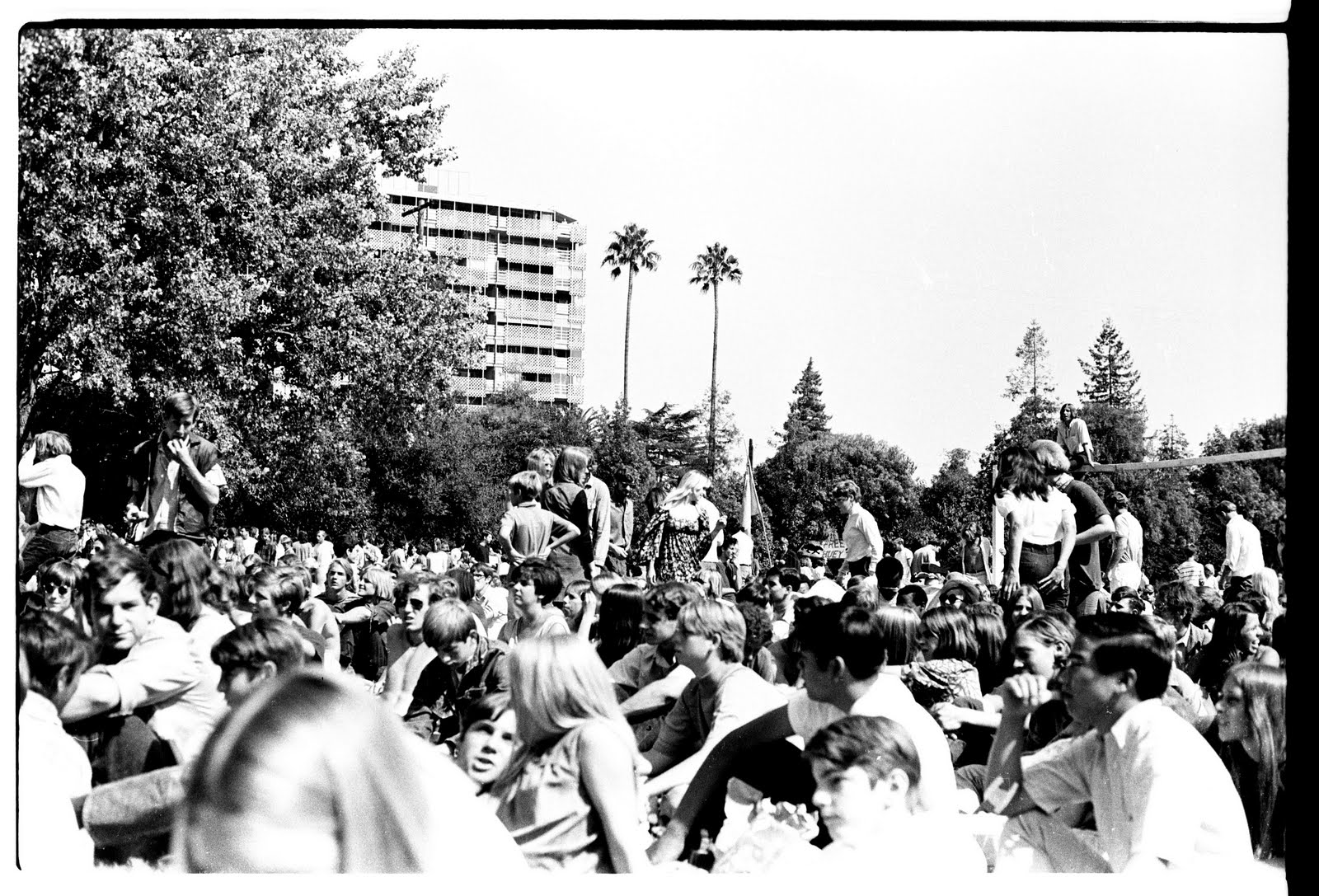
Not to be dissuaded by this experience, and with the Stanford Summer Rock show under my belt, I somehow convinced my folks to let me ride my bike to the Be-In held on September 29, 1968. This time, undeterred by uncomfortable family members, I stayed pretty much the whole day and, camera in hand, got to document a very memorable day of music. The event was nonetheless somewhat of a culture shock for me. I think it was the first time I saw such widespread consumption of pot and even alcohol, and there were also a few audience members letting their freak flags fly, so to speak. Paradoxically, it was also quite a family event, as demonstrated by the many young children hanging out on and near the stage. I guess I approached all of this with the eye of a cultural anthropologist and focused on the music. For this show, the stage was set up at the north end of the field, and you can see from the photos that the P.A. and onstage sound reinforcement was very primitive relative to what you see at a typical rock show today.

 Like the Frost shows, the rosters of artists at these events tended to be pretty fluid, so you could never be sure quite who would actually perform. The posters for the September Be-In promised Quicksilver Messenger Service and the Youngbloods but, unless either played in the gathering darkness after I left, they were no-shows. However, Quicksilver manager Ron Polte’s stable was well represented by two fine groups that, regrettably, did not make much of a commercial impact at the time, Freedom Highway and Phoenix.

Freedom Highway was a San Francisco band dating from the earliest days of the confluence of musicians that ultimately gave birth to the ballroom scene. According to guitarist Richi Ray Harris, they were regulars at Rodney Albin’s jam sessions at 1090 Page Street in 1966, where they were heard by Bill Graham, who offered them a gig at the Fillmore opening for the Buffalo Springfield and the Steve Miller Band (April 28-30, 1967). They also came under Polte’s management wing early on, and often shared bills with other West Pole (Polte’s management company name) artists like Quicksilver, the Ace of Cups, and Phoenix.
Freedom Highway 9/29/68 (From Left: Scott Inglis, Gary Phillipet,
Bruce Brymer, and Richi Ray Harris) Photo: M. Parrish

For most of 1968, Freedom Highway consisted of guitarist Ray, second guitarist Gary Phillipet, drummer Bruce Brymer, and bassist Scott Inglis.  I remember a high energy set with plenty of interplay between the two guitarists but, in the absence of any recorded material for comparison at the time, can’t provide a lot more information beyond this photograph. Miraculously, a Freedom Highway LP (now on CD) was released in Germany in 2002 and is available now on CDBaby. This disc, recorded in Freedom Highway’s house in 1968 and 1969 by engineers Bruce Walford and Paul Stubbelbine, reveals a sound that references both Quicksilver and Moby Grape, featuring memorable melodies, nice harmony singing, and relatively concise performances relative to some of the indulgences of the era. In 1969, Inglis was replaced on bass by David Shallock, who had worked with the Sons and subsequently played in the post-Janis Big Brother before returning to the Sons in both their seventies and 90’s-21st century incarnations.

Phoenix 9/29/68 (From left - Ed Levin, Jef Jaisun,
Stan Muther) Photo: M. Parrish
Phoenix 9/29/68 (from left: Tom Hart, Thomas Dotzler,
and Jef Jaisun) Photo: M. Parrish
Dotzler, Hart, and a fan 9/29/68. Photo: M. Parrish
Following Freedom Highway was another San Francisco group, Phoenix, whose lineup, carefully documented at the Chicken on a Unicycle website. At the time of the Be-In, Phoenix was a six piece, consisting of guitarists Stan Muther and Warren Phillips, drummers Tom Hart and Ed Levin, multi-instrumentalist Thomas Dotzler, and bassist Jef Jaisun.  Unlike Freedom Highway, no recorded music from Phoenix has ever been commercially released or, to my knowledge, distributed among collectors, but I recall their improvisations being much more extravagant, and Jaisun and Levin’s bare shirts and Phillips’ and Muther’s posturing and proto-head banging could have served as physical (but definitely not musical) models for many heavy metal bands.  As documented in the Chicken on a Unicycle Family Tree,  Phoenix experienced some cross-pollination of personnel with another band, Mount Rushmore, which at one time included Dotzler, Phillips, and Levin. Mount Rushmore released two albums, now available on a single CD High on//1969, but none of the Phoenix members play on them (although they apparently featured a number of Phillips-penned tunes).  Jaisun left Phoenix in late 1968,  scored a cult hit with his witty solo single “Friendly Neighborhood Narco Agent,” and is now a respected blues and jazz photographer. Phoenix continued for another year through a number of additional personnel changes, breaking up at the beginning of 1970.

Bobby Winkleman and Ross Valory 9/29/68
Photo: M. Parrish
Jack King, David Denny, and an athletic Jimmy
Warner  9/29/68.  Photo: M. Parrish
Both of these bands were received enthusiastically and, as can be seen from the photos, attracted a large number of very young kids on and near the stage. However, the audience really resonated with the next group, Frumious Bandersnatch. Although they never performed much outside of the Bay Area, and only released one EP during their initial tenure as a band, Frumious Bandersnatch’s members are familiar to many for their subsequent musical endeavors.  Most of the band did stints in the Steve Miller Band, and bassist Ross Valory and early member George Tickner were in the original lineup of Journey.  At the time of the Be-In, Frumious Bandersnatch was in its best known and most stable lineup comprising guitarists David Denny, Bobby Winkleman, and Jimmy Warner, bassist Valory, and drummer Jack King. With their three guitar attack, soaring harmonies, dynamic stage presence, and crisp songwriting, Frumious Bandersnatch deserved a bigger spot in rock history than they have received. One audience member who was mightily impressed by Frumious Bandersnatch was Steve Miller, who by 1970 had recruited 4/5 of the band (Valory, King, Winkleman, and Denny) to shore up his own group when his ‘classic’ lineup gradually splintered during the next year or so. Today a surprising amount of Frumious Bandersnatch material is available on CD, including their original EP (on a compilation called  The Berkeley EPs: Nuggets From the Golden State),  a disc of studio recordings called A Young Man's Song, a privately released set of additional studio outtakes featuring a trio of Warner, Winkleman, and bassist Jack Notestein, and a fine 2008 reunion disc, Flight of the Frumious Banderstatchthat is available on CD Baby. They even have a Myspace Page. Finally, meticulously researched family trees for both Frumious Bandersnatch and the Steve Miller Band can be found on Bruno Ceriotti's fine San Francisco Sound website.

Tim Davis and Steve Miller 9/29/68
Photo: M. Parrish
Miller was the last act I caught, and I suspect his was probably the last band to play, as he was still on and darkness was approaching when I left around 7 PM. Although the five piece Steve Miller Band comprising Miller, keyboardist Jim Peterman, bassist Lonnie Turner, drummer Tim Davis and guitarist Boz Scaggs did not break up until later in 1968, Miller played that afternoon in a trio configuration with just Turner and Davis. Perhaps for that reason, the music he played was more blues based than what I expected based on his ethereal first two Capitol albums Children of the Future and Sailor. I remember for sure that he played "Mercury Blues" and "Your Old Lady," both of which appeared on the wonderful (but regrettably out of print) soundtrack to the 1968 film Revolution. Miller had played the night before at the Fillmore West, filling in for Michael Bloomfield for the live Super Session gig that came out as The Live Adventures of Mike Bloomfield and Al Kooper. As documented in Al Kooper’s liner notes from the album, another guest guitarist that evening was Carlos Santana, and Miller apparently invited Santana down to Palo Alto the next afternoon to sit in for part of his set. Since I had heard the still unrecorded Santana a few weeks before, I knew what to expect, and the two played off each other with aplomb. Unfortunately, I ran out of film earlier in Miller’s set, so I did not get to document their collaboration photographically.
Dancers, El Camino Park 9/29/68 Photo: M. Parrish

Over the summer of 1968, the MFU ran afoul of the Palo Alto City Council over the noise generated by the Be-Ins. Although the sound system’s power was minimal compared to arena sound reinforcement today, there were sufficient complaints from residents nearby that the MFU’s permit was pulled in July. The council decision was appealed in court and ultimately overturned, but the September event turned out to be the last of the El Camino Park Be-Ins. Needless to say, they went out with quite a bang. 

Tuesday, September 7, 2010

The Airplane and the Dead at Stanford 66-67

As the San Francisco Bands were building an audience and looking for places to play, it was inevitable that they would turn their attention to some of the universities in the Peninsula. This was particularly true of the Jefferson Airplane and the Grateful Dead, as they had deep roots in the folk clubs of the mid and south peninsula. Still, given the proximity to San Francisco and the potential of large audiences of college students, neither group played the Palo Alto area particularly often after they became established. The last Airplane show, discussed below, was in May, 1967 and the Dead did not play the Stanford Campus at all between the 66 gig discussed here and their memorable performance at Maples Pavilion on Feb. 9, 1973.

Finding information on rock, jazz, and folk performances in the mid-Peninsula area is challenging because they were only infrequently listed in the San Francisco Chronicle and were all but ignored by the Palo Alto Times and San Jose Mercury News. However, the Stanford Daily proves to be a font of such information, between calendar listings and advertisements. A recent perusal of the microfilm records of the Daily during the mid-1960s yielded some specifics about the early performances by the Dead and the Airplane, as well as some obscure records of a few other concerts held at Frost Amphitheater in in the mid to late ‘60s.

I’ll start off with a real curiosity, from the California Avenue shopping district of Palo Alto. Somewhat of a second downtown, California Avenue was at one time a real downtown of a separate community, Mayfield. Mayfield was annexed into Palo Alto in 1925. Mayfield’s original downtown remains a popular shopping and entertainment area, drawing many from the adjacent Stanford Community. In the latter third of the 20th Century,  the region was home to a great music venue, originally called Sophie’s and later renamed the Keystone Palo Alto. But what I want to highlight here is a short, but tantalizing remnant of a different establishment that sprouted across the street from the future home of the Keystone, at the corner of California and Park Avenue. The Red Hat, established on Sept. 24, 1966, advertised “Grandly Terrific Paranorma, Nocturnal Banquets, and Libations.” What was particularly interesting, however, was a brief writeup of the Hat in the Stanford Daily, which alluded to a run there by a band called “The Hasty Assembly,” made up of the best of several professional bands, including Rose Anne, original singer of the Jefferson Airplane.” Airplane fans know that the group’s original singer was Signe Anderson, and none of the Airplane biographies mention a Rose Anne, so either she played the folk clubs with some of the Airplane members before the band was established, but is seems unlikely that she was in the Airplane per se. One wonders if the Hasty Assemblage might have included some other musicians who went on to greater success in later aggregations. Alas, this is their only mention, and the two items shown here were the only references I could find to the Red Hat in the Daily. For the last several decades, the corner where the Red Hat was situated has been occupied by venerable watering hole Antonio’s Nut House. 

Anyway, back to the Airplane. It appears that they performed twice at Stanford. The first show, a co-bill with the Butterfield Blues Band, was held October 6 at the Stanford Basketball Pavilion. This was not Maples, where the Dead played in 73 when it was newly built, but what was subsequently called the “Old Pavilion” and more recently remaned the Burnham Pavilion, which appears to have had a capacity close to 2000 for a concert setting.

On October 6, the Airplane and the Butterfield Band were in the midst of a co-billed engagement at the Fillmore and Winterland (they played together in SF 9/23-25, 9/30-10/2, 10/7-9, and 10/14-16, certainly one of the longest runs ever at a Bill Graham venue).  On the last day of the Fillmore run, Signe Anderson , who left the Airplane to have her first child, was replaced by Grace Slick, but she would have been on hand for the Stanford Show. The Butterfield Band was also at the height of its initial power during this run, with Michael Bloomfield and Elvin Bishop sharing lead guitar duties on extended versions of tunes like “The Work Song” and their trademark improvisational extravaganza “East West.”  Tickets for this show, sponsored by the Stanford Senior Class, ranged from $2 to $3.50.

Incidentally, this is not the only time the Butterfield Band played on campus. Here is a poor quality scan of a photo, credited to photographer Tom Wong, showing the Butterfield band at a Friday afternoon performance as part of a series of Chicago blues bands.

Seven months later, the Airplane was invited back to campus, this time to play at Frost Amphitheater in a co-bill with comedian Dick Gregory. Unlike later Frost rock shows, this one featured chairs and reserved seating, with tickets ranging from $1.75- 3.25. This was the most familiar Airplane lineup, comprising Slick, Airplane founder Marty Balin, guitarists Paul Kantner and Jorma Kaukonen, and the rhythm section of bassist Jack Casady and drummer Spencer Dryden. In these few months, the Airplane had morphed from a fairly polite folk rock band into a psychedelic force of nature, as evidenced by a bootleg performance of their show two weeks later at Cal Poly San Luis Obispo, where they mixed older material with harder edged material like “White Rabbit” and “Saturday Afternoon/Won’t You Try.” The Daily published an uncredited photo from the Frost event that also included the following succinct review as a caption: This is the Jefferson Airplane. They make music, sometimes. They also make commercials for white Levi’s. They played at Frost Amphitheater on Sunday. They stank.” Had you been there, your mileage might have varied, but the Daily reporter was clearly not impressed.


Perusing the Daily archives through 1970 failed to turn up evidence of another Airplane performance at Stanford, and certainly not a co-bill with Santana, which is why I asserted in a previous post that it was most likely that Michael Shrieve would have first heard Santana at the 7/28/68 Summer Rock show rather than at a show where they supported the Airplane.  Although the Airplane played numerous shows during ’66 and ’67 in San Jose and at Santa Clara University (Kaukonen’s alma mater), and then performed at the Northern California Folk Rock Festival on 5/18/68, it, surprisingly, appears that the May show at Frost was the last time the group played in the Palo Alto/Stanford area.

It is well known that the Grateful Dead got their start in the Palo Alto-Menlo Park area, and members of the group undoubtedly played the area folk clubs scores of times.
Their show, held on at the Tresidder Memorial Union, had an admission cost of $1.25. The location was identified on the ad as the TMU Deck, which I believe corresponds to the union’s back patio, where classical and jazz concerts are held today.

While I was researching these shows in the Daily microfilm archives, I came up with a few other interesting shows that took place at Frost during that era.

First, three weeks after the Airplane/Gregory show, R&B star Wilson Pickett played the venue.

A couple of months after the Summer Rock show, on 9/24/68, the Associated Students of Stanford sponsored a concert with the Youngbloods and Sundown Collection. This was notable in being an evening concert, starting at 8 PM. As Frost does not have lights, the logistics of this show would have been interesting, to say the least - a bit like trying to play baseball at night at Wrigley Field before they put in the lights. The Youngbloods, fairly recently arrived from the East Coast, were coasting on the first top 40 run of their cover of Dino Valenti’s Get Together. At this point, they would have been in their original quartet configuration comprising front man Jesse Colin Young, guitarist Jerry Corbitt, multi-instrumentalist Lowell “Banana” Lovinger, and drummer Joe Bauer. Over the next year or so, Corbitt would leave, the band would pick up bassist Michael Kane, and they would come to epitomize the west Marin County laid back lifestyle.

The Sundown Collection were a pioneering country rock band, based in Los Angeles but originally from Fort Worth, Texas. The group, which never recorded, featured John “Rabbit” Bundrick, who went on to play with Bob Marley and a bunch of British rockers including Free and the Who, with whom he has toured since the 1980s to the present. The group had hopes for a major recording contract, but they broke up before one materialized.

I will get to some of the other notable shows held at Frost in 1969-1070 in a later post.